Primavera Film Review
Summary: “Primavera” is a period drama with a feminist slant that features the composer Vivaldi. An atmospheric film that ultimately celebrates the power of music.
4
Viva La musica!
“Primavera” may be a film featuring composer, Antonio Vivaldi, but he is not the star. This period drama is actually all about one of his fictitious pupils. It’s unexpectedly pleasing as it draws inspiration from some historic events. At its core it is about a young orphan girl who has her talent subjugated in a cloistered, man’s world.
Opera director, Damiano Michieletto delivers his first feature film here. He also co-writes the script along with Ludovica Rampoldi, which is adapted from a novel by Tiziano Scarpa. It has to be noted; the finished product does take some liberties with historic events. But if you can look past that, it’s more important to consider that this film celebrates one young girl’s liberation through music, and that is one helluva powerful force.
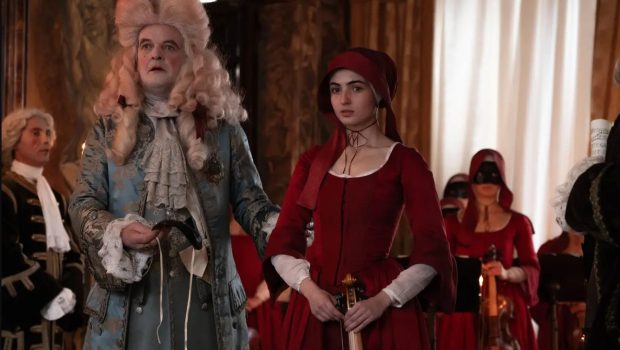
Tecla Insolia stars as Cecilia, a virtuoso violinist. She was abandoned by her mother at the Pio Ospedale della Pietà orphanage as a young child. Cecilia is a strong young woman. But she grapples with this fact and writes many letters to her mother, willing her to return and claim her.
Life at the orphanage can be quite iron-clad as the prioress (a stern, Fabrizia Sacchi) rules with an iron fist. The prioress is unbearably cruel in the opening scene, which sets the tone for the remainder of the film. The orphans are her charges and they dress like the subjugated women in “A Handmaid’s Tale.” Those women who are lucky and smart enough are trained in music and play as part of an orchestra. Except that they perform behind masks or enclosed in a grille.
Cecilia’s future looks like it’s pre-ordained, as she is promised in marriage to a war hero and orphanage patron (Stefano Accorsi). However, this destiny is challenged when the orphanage’s director (Andrea Pennacchi) employs the sickly Vivaldi (an unassuming, Michele Riondino) as the orchestra’s music master. A chaste priest, he identifies Cecilia’s talents and promotes her to first violin.
This film is set in Venice during the 18th Century. It is rather handsomely shot and feels authentic to the baroque period. The costumes worn by the wealthy are really opulent and are a stark contrast to the functional uniforms the orphan girls wear. At the film’s heart is Vivaldi’s incredible music. This features prominently and is worth the price of admission alone.
Insolia really carries this film with Cecilia’s quiet defiance. Audiences will be rooting for her even when she faces various setbacks and outright cruelty. She is earnest and shares an excellent chemistry with her teacher. It is an interesting dynamic to watch unfold.
“Primavera” is an atmospheric film that will stun audiences with its quiet, contemplative approach. It can be a tad predictable and only partially historically accurate, but it does tell an interesting, feminist story with real heart. “Primavera” is ultimately a celebration of music as liberation for both the self and the soul. Charming.
About the Author

Natalie Salvo Natalie is a Sydney-based writer and lover of all things music, food, photography comedy, art, theatre. You can find her digging in crates at good record stores.
Related Posts
Johnny Depp Makes Surprise Ebenezer Appearance at SDCC + Introduces New Trailer! →
Tenor: My Name is Pati Film Review →

Imprint Films September SteelBooks – DEATHSTALKER COLLECTION & RED SONJA →