
Ultrahuman Ring Air Review
Summary: The Ultrahuman Ring Air presents a premium offering without the premium subscription price tag. It's only slightly less accurate with slightly less battery life, and for most people the difference in budget might outweigh the aesthetic and tech differences.
4.5
Premium Ultrahuman
The Ultrahuman Air immediately lived up to its name. Its weight is almost wisp-like, easy to forget it’s even there. It did not track as accurately as I expected for activity or heart rate compared to another premium smart ring, but the Ultrahuman Air offers a broader range of data on health metrics without an additional subscription. On balance, it strikes me as an affordable alternative to premium-priced competitors like the Oura, with the caveat that it will not always be as accurate, and it has slightly shorter battery life. But given the breadth of data it offers in granular detail, I imagine anyone who wants to ‘tinker under their hood’ will enjoy the Ultrahuman experience.


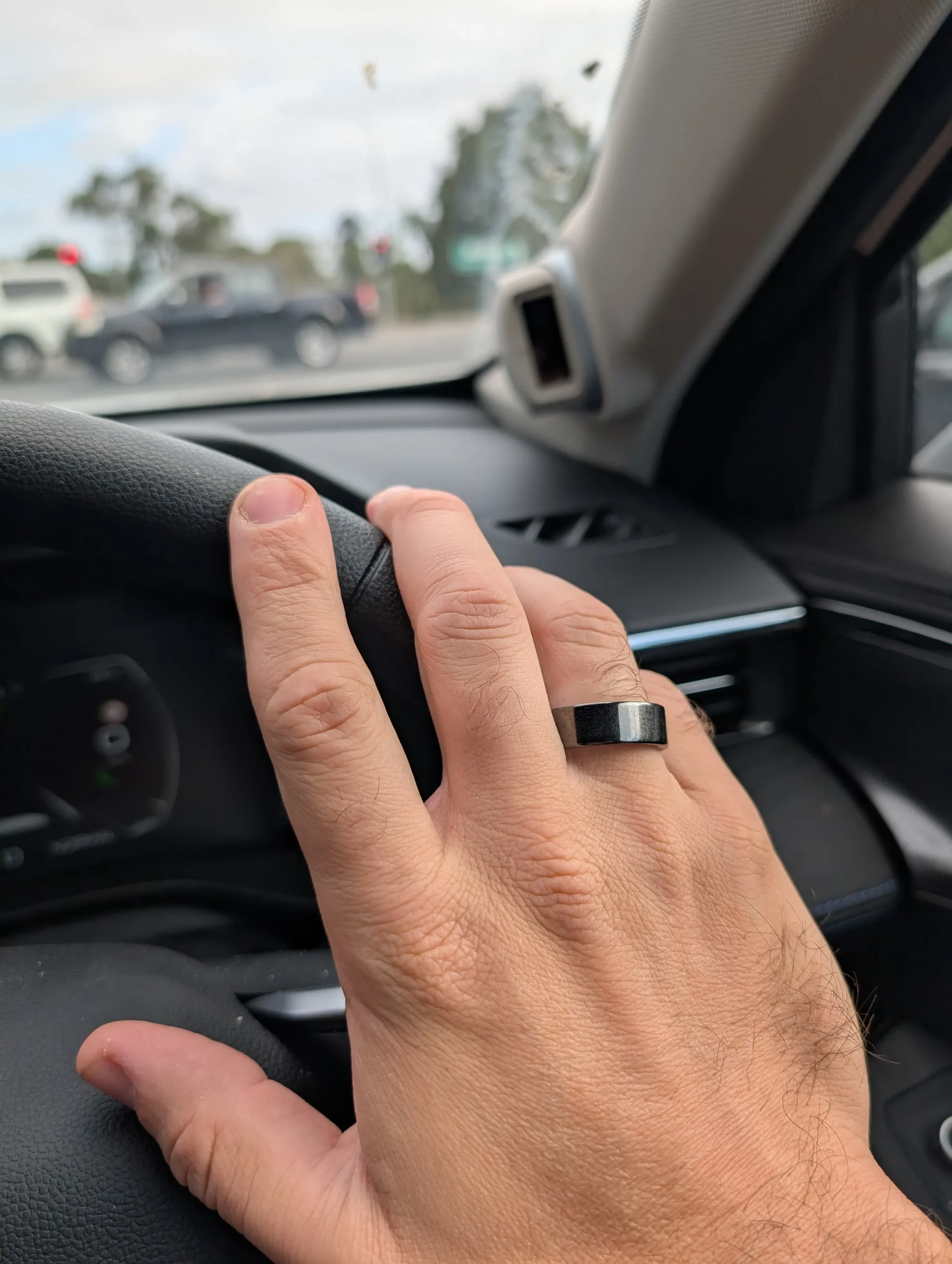
I’ll speak to the aesthetic first. The Ultrahuman Air arrives with intent – opening the box comes with ‘cool’ stickers, a ‘hello cyborg’ greeting, and the Ultrahuman app leans into the borderline-militaristic video game HUD art style. Compared to both the Oura Ring 3 and Ring 4, it is incredibly, impressively light. Ultrahuman claims the ring is manufactured from ‘jet-grade’ titanium with a tungsten carbide coating…when I read that, I assumed it would feel like an indestructible band, as heavy as the tungsten rings I tested before choosing my wedding band. The fact that it doesn’t weigh your finger down is both a pro and a con. I loved how light it is despite the relative sophistication of its sensing capabilities. But it also feels like it would break if I pinched too hard, and the edges feel very plastic compared to the Oura 3 (let alone the recent ceramic Oura).


I tested a size 10 and it fit equally well as the size 11 Oura, which struck me as strange. However, the ring itself is less bulky and torus-like and therefore seemed to always fit a bit more securely. Setup and startup were simple with easy instructions: just a quick charge before connecting to the Ultrahuman app; only a few minutes of ‘failed’ connections before success, simply trial and error. The app told me I needed to wear the ring for at least 2 weeks before I would get an ‘Ultra age’ – every other data module began populating useful data and hints within one day and night of wear. The battery seems decent with literal days of charge, usually 4 to 5 with the way I have used it – although it keeps offering me “chill mode,” which it promises will extend battery life.


The breadth and detail of data available is both impressive and a little overwhelming. Imagine being in the cockpit of a large commercial plane, at night, with all the screens and lights – when I first opened the app I wasn’t sure where to look, let alone start. Whilst it was less intuitive than the Oura app, or other wearable tech apps from Samsung, Google, Fitbit, or Garmin, once I acclimatised to the endless array of green and red text and highlights, I realised I was being fed more raw data in greater detail than most of the competitors combined. I’m going to read into the Ultrahuman schtick a little, cued by the ‘hello Cyborg’ greeting on the manual – I think it’s reasonable to assume the data from the Ultrahuman Air leans into the ‘body as a machine’ idea, and by feeding you data you will be able to optimise your performance, just like tinkering with a car (or for the gamers, figuring out how to maintain framerate with graphical performance when playing a demanding AAA release on older machines).

I was a little bit bugged by the frequency of notifications from the Ultrahuman app. I actually checked the app less than I would have liked because I began to see the notifications as interruptions to my day, rather than reminders to ‘check in.’ However, the bedtime wind-down alerts, and the notifications to avoid caffeine after a certain time or certain light spectrums to assist with sleep, were a clever addition to the experience. Overall, I think the issue is more stylistic – despite being a relatively ‘hardcore’ gamer, I felt I lost sight of the forest for the trees when I was reviewing the data, and started wondering how useful it really was to focus on numbers rather than outcomes. This is especially true when I compare it with a similar premium smart ring application, the Oura, and how they paired a smaller amount of data with hints and tips for behaviour change. So I suspect mileage will vary with this – if you’re the kind of person who hates being told what to do by an app, and prefers to see ‘under the hood’ of your body, then the Ultrahuman Air’s data is probably more your style.


When deciding if the Ultrahuman Air is for you, it probably comes down to the data tracking it offers for the price point. My impression is a bit mixed. I’ll start with the highlights – the breadth is impressive, and it is included in the original purchase. I’ll emphasise again: for all the metrics I tested, there was no ongoing subscription. There are “power plugs” – some of which are free and offer useful insights for things like ovulation cycle tracking, shift work, etc. – and some of which require an ongoing subscription fee (think $5-$10/month). There is the ‘caffeine window’ included with the base purchase, and the depth of data tracking is pretty intense and granular. And it is all included, out of the box, with no ongoing subscription – which is significant, particularly compared to the Oura, which will cost you over $100 AUD extra each year. Of course, there is the almost obligatory subscription model with tailored insight, but I never felt any need to consider the extra features at the extra cost.


However, the accuracy of this tracking seemed quite variable during my review. The Ultrahuman app often told me I had been asleep when in fact I had been awake, looking at a baby monitor, wishing I was asleep, sometimes for over an hour. One morning it alerted me to having stayed up late the night prior (1:45 a.m.) despite my going to bed around 10:15 p.m. and getting a brief sleep before I was up with the kids from 11:50 p.m. Heart rate accuracy seemed particularly questionable during my review, both at rest and with activity – and I stopped bothering with activity tracking pretty early given how little utility it had. I think for most people, most of the time, it is mostly accurate on average. It is likely ‘fine’ and not a significant issue most of the time, because not many of us are budding elite athletes who rely on accuracy for peak performance and recovery. But at over $500 AUD, I think it is worthwhile knowing that the sophistication of sensors and data presentation will not necessarily mean highly accurate tracking consistently, particularly if you are considering the Ultrahuman as an alternative to similarly priced smart wearables.


Final Thoughts
Overall, I was impressed by the technology of the ring, and still can’t believe how light it is…but a little disappointed that despite the premium price tag of more than $500 AUD, I was sometimes unsure if I was wearing a plastic band or a ‘jet-grade’ smart ring. The Ultrahuman Air would be an easy smart ring to recommend for the price point and the features it offers with NO ongoing subscription – if I had not noticed the inconsistency of data tracking. Once I experienced this, and was able to repeat it, my confidence in the rest of the insights the Ultrahuman Air app provided was reduced. The Ultrahuman Air is likely a very strong choice if the price tag of more premium niche products feels sour, and for those who want more control over how they use their data – without the burden of an ongoing subscription. 4.5/5 stars

Related Posts

AMD unveils the Ryzen 9 9950X3D2 for Developers and Creators →
Aussies Urged to Back Up Their Data This World Backup Day →

Razer’s Thinnest Gaming Laptop Evolves: Introducing The 2026 Blade 16 →