
Reigns: The Witcher Review
The Binary Witcher
Summary: PC is definitely not my number one choice to experience the new adventures of Geralt. Though the game captures the essence of CD Project Red’s The Witcher series, at the end of the day, it’s just a casual card adventure, not a full-blown RPG, and that will make it difficult to keep up with the experience longer than a short while.
3.6
A Different Kind of Witcher
When it comes to turning beloved franchises into casual card game adventures, the Reigns series from Nerial studio is one of the best examples. This time with Reigns: The Witcher, the devs behind Reigns: Game of Thrones take us back to yet another fantasy world that has been out of the spotlight for a while.
Reigns: The Witcher is actually the story of Dandelion, the famous bard and friend of Geralt of Rivia. As Dandelion and Geralt journey through the land for new monster-slaying adventures, they stop at inns at the end of the day, where the bard sings his songs to the crowd; songs about the witcher’s deeds and stories. This is where the game begins.
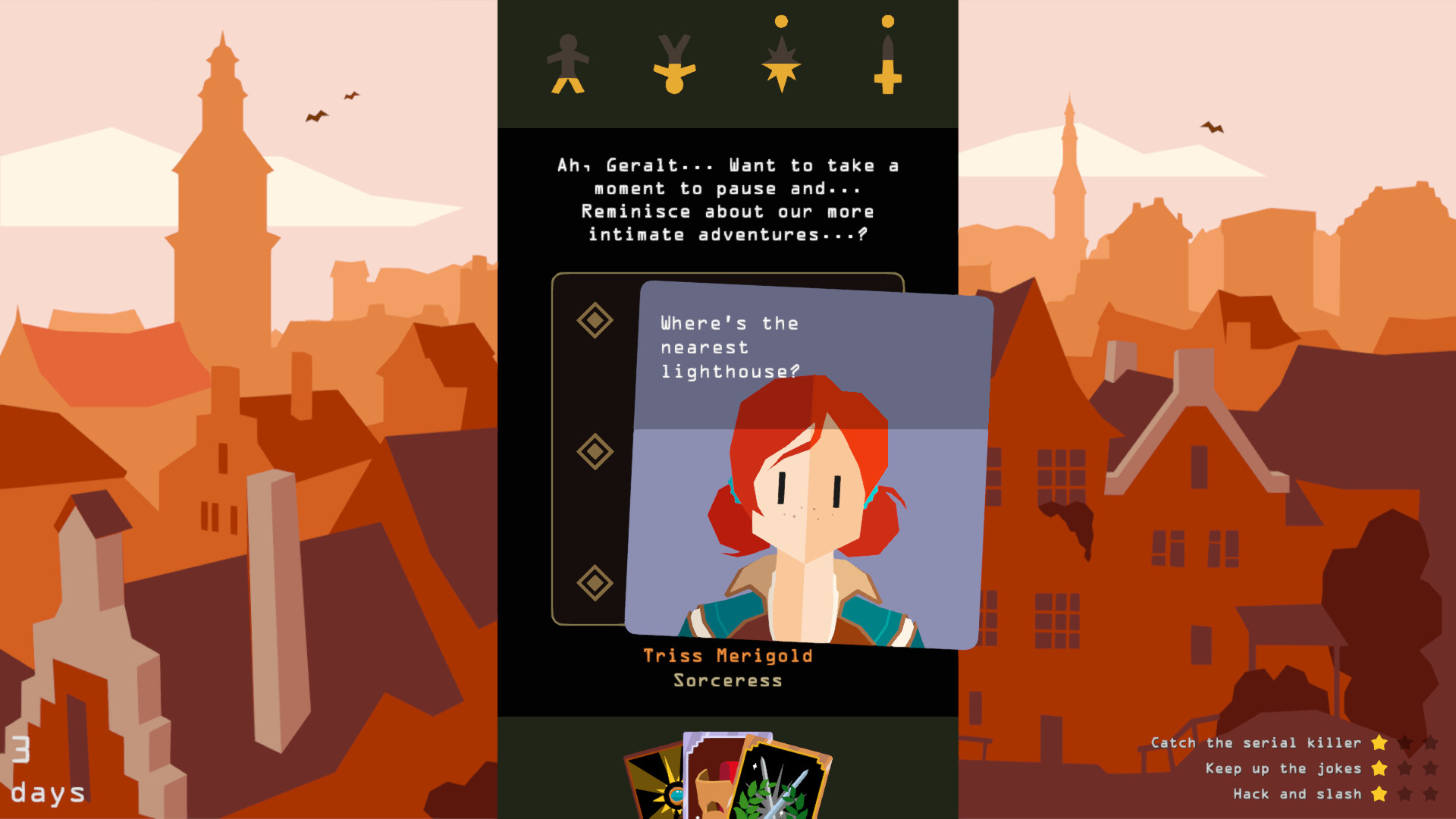
As the bard tells the story, the player has to choose between two cards, each leading to a different path. Would the witcher help an old merchant reach the top of her shelf and get some needed ingredients, or is he too busy for such mundane acts of chivalry? Would Geralt help a sorcerer with her experiment on halflings for a price, or would he rather help the non-humans escape? As players make the choices and the story unfolds, Dandelion becomes more experienced and new stories, or as the game calls them, “Inspirations,” are unlocked, following Geralt as he completes new and even bizarre quests or even unlocking new private gigs for Dandelion to perform focused on VIP audiences across the land. The binary of choices represented by two cards is what makes up most of the game, but there is a fame system that adds higher stakes to the seemingly tiresome choices.
As Geralt kills monsters, helps humans, sides with non-humans, and interacts with sorcerers, his stance with each group changes. The more he helps humans, the more non-humans and mages distance themselves from him. If he becomes too focused on helping elves and dwarves, humans will look at him with even more disgust than they usually do when seeing a mutant. Thus, players need to choose how the story progresses while keeping an eye on the fame meter on the screen that shows Geralt’s love/hate relationship with each faction. If he reaches maximum hate or love with any faction, that’s when the story ends abruptly, whether by being hanged by the neck for treason against the kingdom and conspiring with non-humans or being assassinated in the woods by Scoia’tael arrows.

What made the game difficult for me was the fact that you can’t fully understand the extent to which each choice affects each faction. Before choosing any of the two cards, players can see which of the four factions are affected by that card, but whether that effect is going to be positive or negative can only be deduced by the players’ comprehension of the text written on the cards. For example, when a human wants to watch a dangerous monster slain before his eyes, and Geralt does it for a price, it should have a positive impact on humans, right? Wrong! It makes him more infamous. Instead, if Geralt hunts down a less dangerous creature, it would make him more loved by humans. Understanding the logic of scenarios like this needs a lot of trial and error, and that is not something I expect from a narrative-driven adventure.
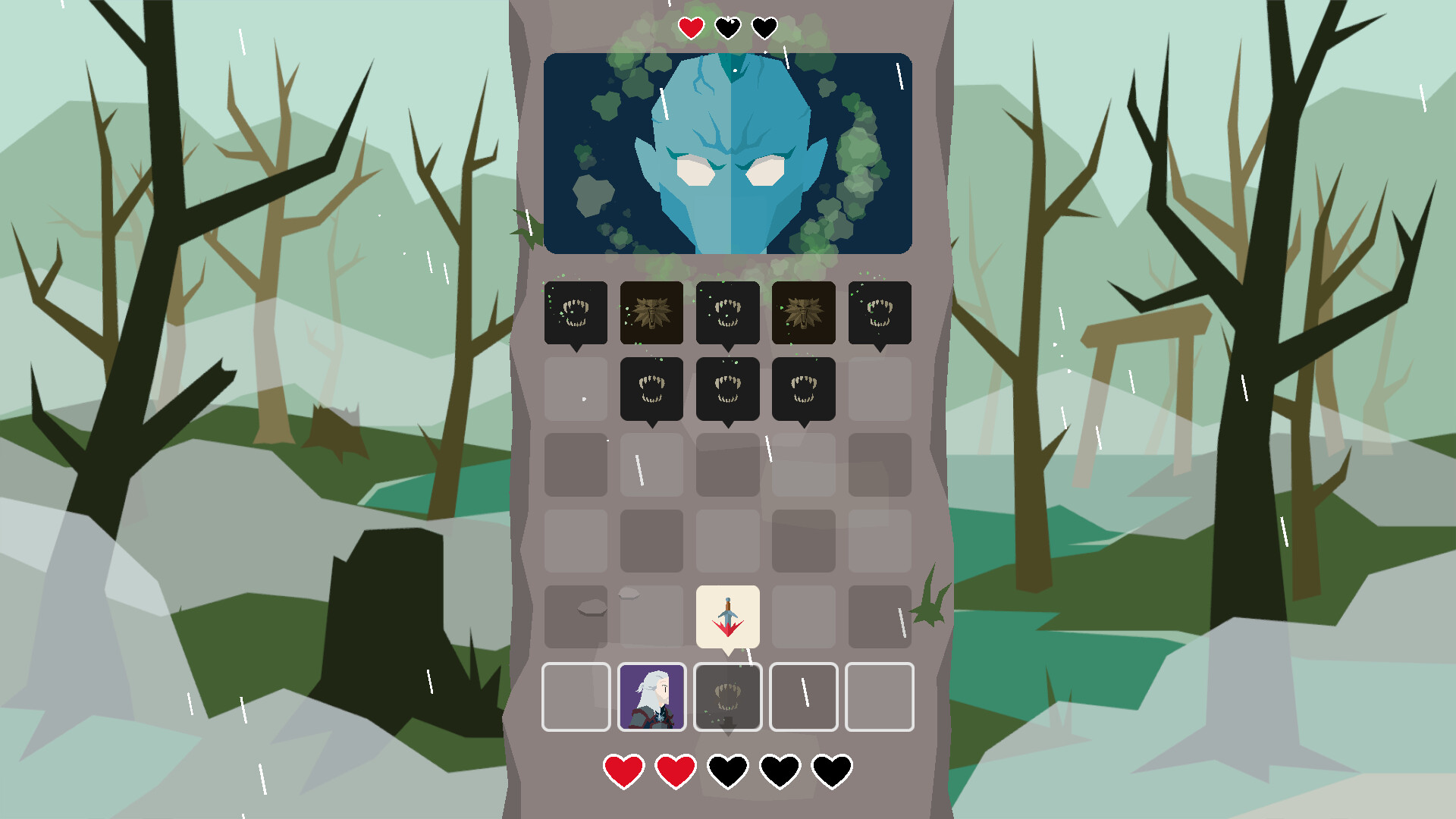
There is also another aspect to Reigns: The Witcher’s gameplay: combat! You can’t have a Witcher game without combat, and that’s why Geralt’s adventures regularly end up with drawn swords and clashing claws. The combat system in the game is more like a Tetris-like minigame in which the players must move Geralt left or right to avoid enemy attacks coming from the top of the board while collecting offensive items such as witcher signs and sword attacks. The combat minigame is simple but never boring as the witcher’s abilities are gradually upgraded, new witcher signs are unlocked, and different types of monsters attack Geralt with special abilities. For example, a Bruxa can slow Geralt’s movement with her scream, or a Manticore could spread poison on the board, damaging Geralt over time. Knowing their audience well, the people at Nerial studio added an option to automate the combat sections of the game for those who want a fully narrative-driven experience as well.
Reigns: The Witcher is a game best played on mobile phones, as “swiping cards left and right” is best experienced on a touch screen. PC is definitely not my number one choice to experience the new adventures of Geralt. Though the game captures the essence of CD Projekt Red’s The Witcher series — including the audio-visual aesthetics — at the end of the day, it’s just a casual card adventure, not a full-blown RPG, and that will make it difficult to keep up with the experience longer than a short while.

Related Posts

ChromaGun 2: Dye Hard PC Review →

Star Trek Voyager: Across The Unknown PC Review →
The Sims 4 Royalty & Legacy Review (PC) →