
No Other Choice – Film Review
Reviewed by Damien Straker on the the 15th of January 2026
Madman presents a film by Park Chan-wook
Screenplay by Park Chan-wook, Lee Kyoung-mi, Don McKellar, Lee Ja-hye based on The Ax by Donald Westlake
Produced by Park Chan-wook, Back Jisun, Michèle Ray-Gavras, and Alexandre Gavras
Starring Lee Byung-hun, Son Ye-jin, Park Hee-soon, Lee Sung-min, Yeom Hye-ran, and Cha Seung-won
Cinematography Kim Woo-hyung
Edited by Kim Sang-bum and Kim Ho-bin
Music by Jo Yeong-wook
Rating: M
Running Time: 139 minutes
Release Date: the 15th of January 2026
In this adaptation of Donald Westlake’s novel The Ax (1997), there is a complex thematic binary at play. South Korean director Park Chan-wook dramatises how far a person will go to protect their family. Yet through parody, he reveals how people convince themselves there is one solution. Actions trump consequences and morality.
As a character mentions throughout No Other Choice, it is not about the incident but how you react. We are aligned with the bleak choices of the film’s protagonist over a distant but agreeable moral viewpoint. The framework edges Choice closer to the complex moral ambiguity of a Scorsese crime drama or Dostoevsky’s novel Crime and Punishment (1866). You are empathising with a tortured soul who is also a violent fool. The dark humour counters the grisly passages, creating an effective tragic-comic view of class warfare and personal agency.
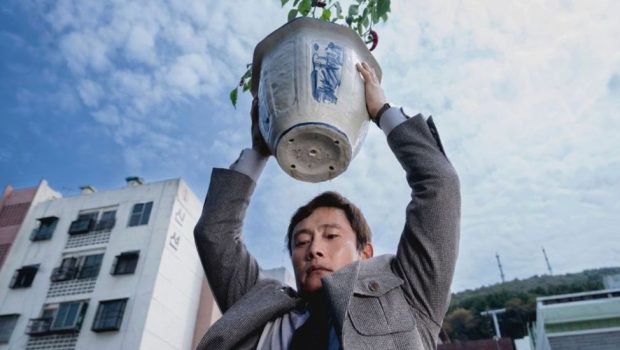
Lee Byung-hun (Squid Game) is excellent in the lead role of Yoo Man-su. Man-su works in a paper company and practices standing up to new American investors who are rapidly cutting staff. Meanwhile, he relishes his home life, including the love of his wife, Lee Mi-ri (Son Ye-jin), and their two children. Their young daughter, Ri-one (So Yul Choi), is neurodivergent and musically gifted. Yet she only plays the cello in their absence! Later, Man-su’s stepson is in trouble with the law and needs help.
Nonetheless, Man-su prides himself on gardening, enjoys dancing with his wife, and is obsessed with paper. However, when he is unexpectedly fired from his job, the family’s money and lifestyle diminishes. Man-su and Mi-ri try making cuts, including sending their two dogs away. The bleeding continues. They must sell the family home unless Man-su finds work. A creepy potential buyer has eyes for Mi-ri. The pressure sees Man-su crumble. Angry and dispirited, he plots to eliminate the candidates vying for a job in another paper company.
Park Chan-wook is an accomplished director who specialises in morally ambiguous psychological thrillers. Oldboy (2003) is a strong example of the bleak foundations permeating throughout his filmography. The same visual flair displayed throughout Oldboy and Stoker (2013) applies here albeit reined in. In the opening, a wide angle shot frames Man-su’s family hugging on the property. The broad angle shows the entirety of Man-su’s world exists in this moment with his family and garden. The shot also underlines the desperation of his actions.
Chan-wook juxtaposes the garden’s naturalism with belated images of a factory run almost entirely by robots. The contrasting images show people can achieve their goals but lose their humanity. Chan-wook’s sound choices are also critical to amplifying this theme. He overlays the factory images with the classical music played by Man-su’s daughter. The music infers how Man-su’s ambition has eclipsed his love of his family. The way the film develops its themes through this audio-vision is strong, but Chan-wook’s jittery editing style remains challenging.

Lee Byung Hun’s layered performance is responsible for effortless tonal shifts. We see how dispirited and anguished he is while unemployed. Byung-hun’s emotion here is critical to eliciting our sympathy. Once Man-su actions his violent plan, his performance register changes. Here Byung-hun proves highly adept at slapstick comedy. There are incredibly funny scenes where he stumbles and bumbles his way towards attempted murder.
One of the best scenes involves a wrestle for a weapon. Chan-wook heightens the soundtrack over dialogue. He trusts the actors’ hilarious physicality alone as they claw over and on top of each other. Another funny moment involves Man-su arriving late to his wife’s dance class. The way he struts across the dance floor to draw her attention is hilarious and self-deprecating. There is also a very nice, multi-layered performance by Son Ye-jin as Man-su’s wife. She turns a potentially superfluous role into a complex character. While disgusted by her husband, she becomes a sympathetic ally. The lead performances see the film narrowly walk between bleak psychology and social satire.
The only shortcoming compares to watching Man-su move on the dancefloor. You will need to keep in step with Park’s twitchy filmic style. The editing can be a little overzealous at times. However, there are some interesting flourishes too, such as when the camera dives headfirst into the bottom of a whiskey glass. The visuals aside, the film works as a bleak but funny satire of determination and single-mindedness. We are aligned with someone convinced there is no alternative to violence. The success of the shifting mood is attributable to Byung-hun’s performance. His emotional range impresses, especially with how sympathetic Man-su is before his soul darkens. He asks us, what are we willing to use as emotional leverage to succeed and best others?
Summary: The film works as a bleak but funny satire of determination and single-mindedness. We are aligned with someone convinced there is no alternative to violence.
3.5
Impressive
About the Author

Damien Straker is a freelance writer and film critic. He studied at the University of Sydney and graduated with an Arts Honours degree in Film Studies. He is a pop culture aficionado and enjoys talking about all films, 90s TV shows, ninjas and watching Rugby League. His favourite film directors are Alfonso Cuarón, Clint Eastwood and Alexander Payne.
Related Posts

Midwinter Break – Film Review →

Sirat – Film Review →

Scream 7 – Film Review →