
Metroid Prime 4: Beyond (Switch 2) Review
Summary: A compelling adventure with an unfortunate case of the Wheaton's that often undermines its more pensive moments.
4
The Legend of Samus
Whenever a game goes through a lengthy and somewhat tumultuous development cycle, as Metroid Prime 4: Beyond has, the first question that always buzzes around my brain is. Was it worth the wait?
In this case, I’m going to say yes. Is it perfect? No. Does it have the fingerprints of the best part of a decade’s worth of development all over it? Certainly. Is this a good thing? It’s complicated.
I will say this, though, I couldn’t put it down.
The latest instalment in the legend of Samus sees everyone’s favourite Metroid murdering bounty hunter, helping the Galactic Federation protect an artefact from a band of pesky space pirates, led by a rogue bounty hunter known as Sylux
However, when Sylux damages the artefact during his inevitable battle with Samus, both bounty hunters (and the team Samus was leading) are transported across the universe to the isolated and surprisingly diverse world of Viewros. A doomed alien world, home to a species of aliens that had found a way to tap into their latent psychic powers by using special crystals stuck to their foreheads. (Guess what Samus finds pretty much as soon as she sets foot on the planet)
Samus soon learns there is a device that might be able to transport everyone back home, but she needs to track down five keys scattered across Viewros to unlock and power the device. Thus begins another adventure where Samus must overcome the environment, return her suit to full power, and ultimately escape. So far, so Metroid.
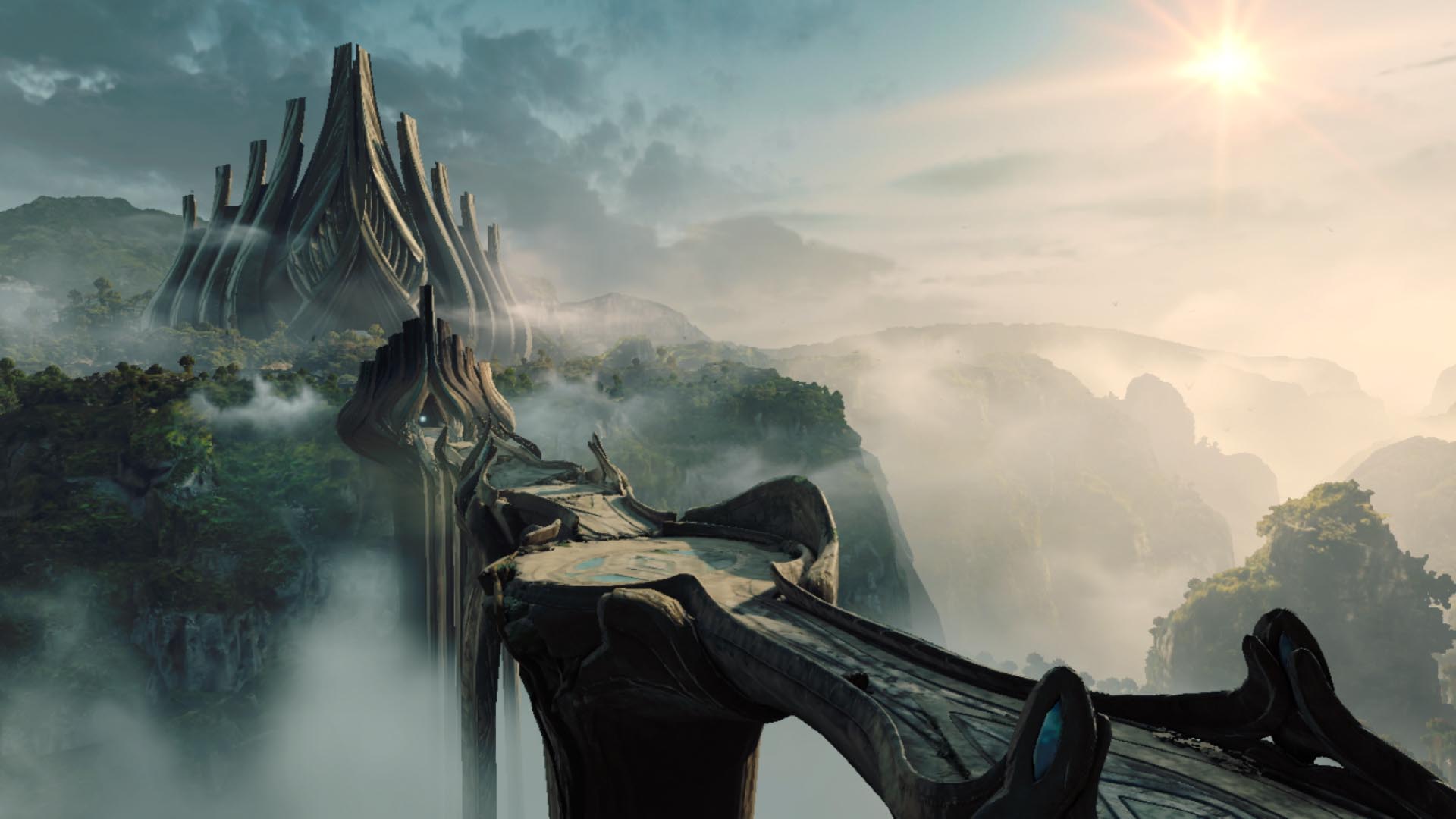
If nothing else, the world that Retro has created in Metroid Prime 4 is as compelling as ever. Those moments of quiet isolation as you’re exploring Viewros incredibly beautiful biomes from the dense, colourful jungles of Fury Green to the freezing Ice Belt that’s home to the planet’s abandoned research base, and the wide, desolate, sun-kissed desert expanse of the Sol Valley that also acts as the world’s hub, are as contemplative, dreamlike, and absorbing as ever.

That pensive sense of isolation, which has always made the Prime series so compelling, is once again in full effect.
That is, until the squad you were working with during the intro shows up to lend a hand, and by that I mean ruin your otherwise peaceful hike, though another meticulously designed map by begging to talk to them on the radio, telling you what to do next, and quipping their way through every situation.
Yes, folks, the ragtag group of soldiers you find yourself in charge of has a terrible case of the Wheatons. It would be easy to blame the MCU and move on, but you get the feeling Nintendo is angling Metroid to be something akin to a PG-rated Aliens reboot, or more like Halo, and I’m not sure it fits as well as they were hoping it would.
I get it, Nintendo has aspirations to make movies out of all their major IP, and Metroid in its current form doesn’t exactly scream blockbuster, and, as much as I would love a Metroid movie that was essentially a cross between Prometheus and Tarkovsky’s Stalker, I just don’t think it would have the mass appeal Nintendo is looking for.
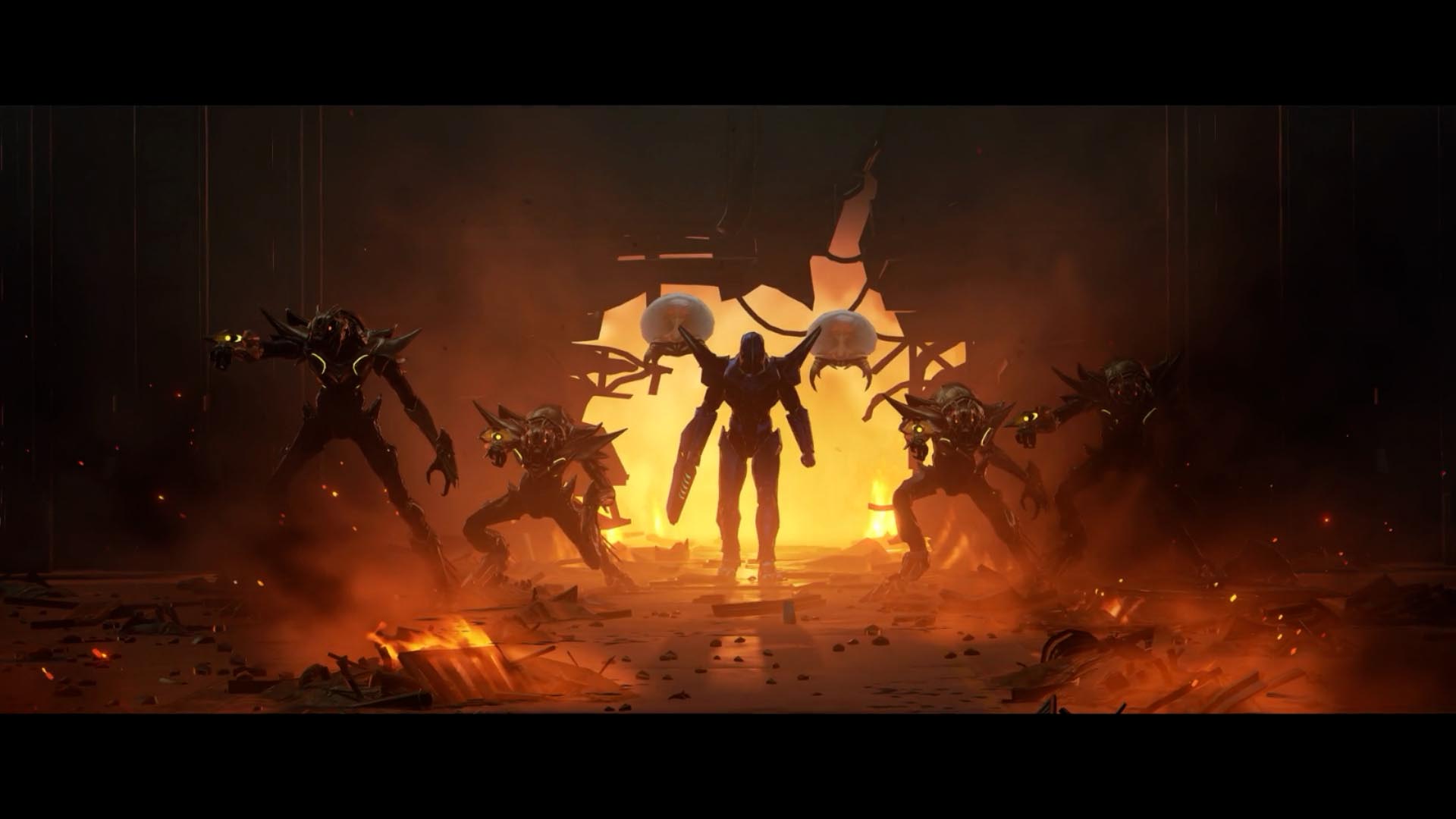
At least it’s not like Other M. In Prime 4, Samus returns to being a caring yet stoic, silent protagonist as opposed to a simpering wreck who desperately wants to impress her dunderheaded sempai, who has a panic attack at the sight of Ripley and insists on asking permission to use her upgrade.
Thank goodness for small mercies, ay. The group isn’t’ that irritating, and they do grow on you as the game progresses; they’re just a little rote. You will be happy to hear that Samus does spend most of the game alone, as Yokoi intended, and the team is basically there to help you shoot things, tell you where to go when you’re lost, and convert the local tech into something usable with your swanky redesigned suit.
I just wish there were a way to turn off the hints.
What’s most intriguing about Prime 4, though, is that it structurally feels more like a traditional Zelda game than Metroid. Sol Valley is basically Hyrule Field in Ocarina of Time if it were set on Arrakis. Vi-O-La is your trusty steed. You start in the forest and then find your next destination by riding off towards that volcano you can see in the distance.
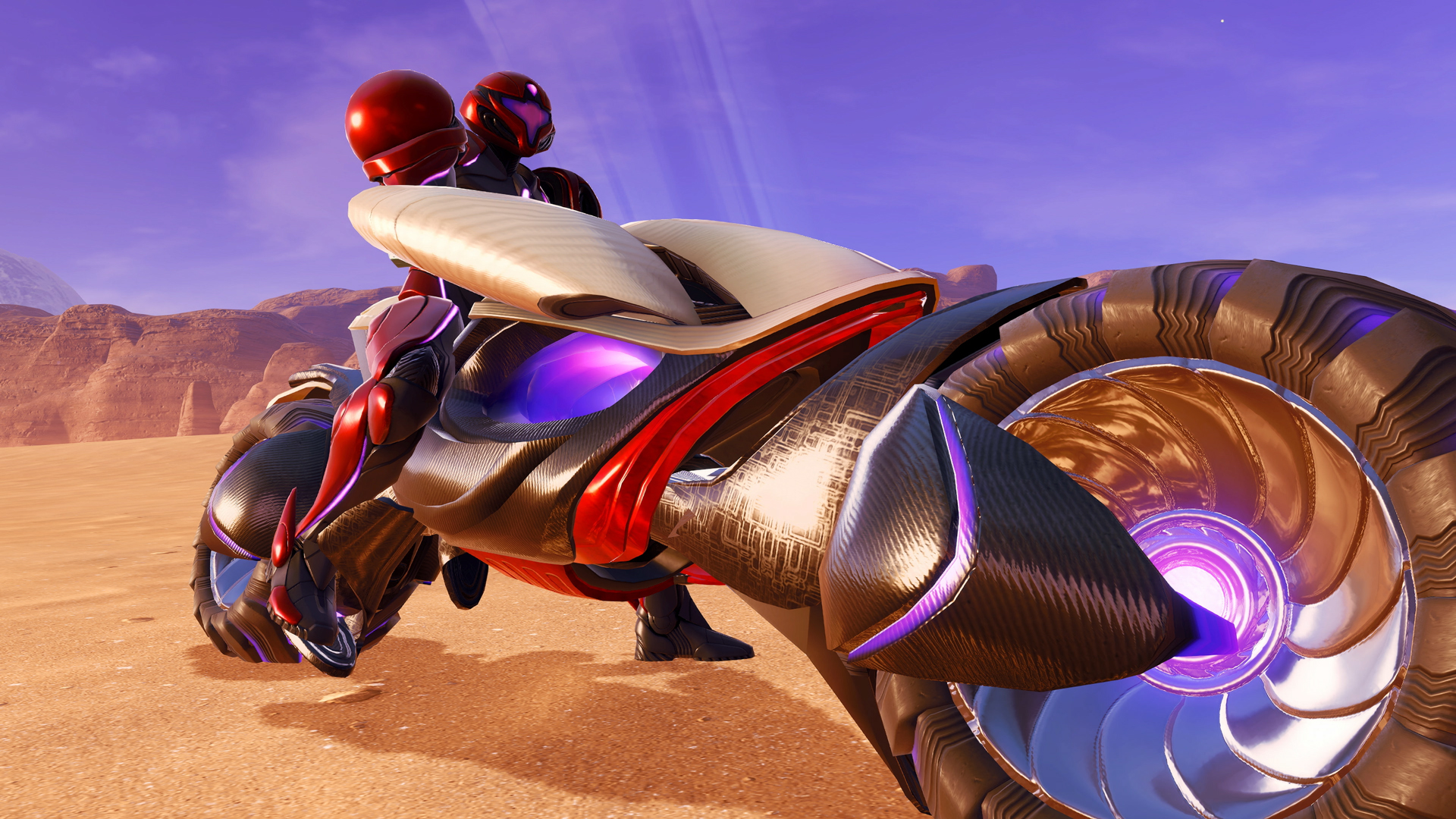
It’s simple, straightforward, slightly more linear than I would have liked at times, and the hub world is fairly barren. However, I didn’t care because whatever I stumbled on was useful at some point, and zipping around on Vi-O-La, smashing through green crystals, then Akira Sliding into the occasional baddie never stopped being fun, looking cool, and feeling great to pull off.
Each of the four main areas you explore is basically dungeons that slowly open up as you find more upgrades, though there is a fair amount in the back end of the game (and if you want to collect and scan everything). Each area is distinct and opens up in that lovely puzzle box fashion that all great Metroid games do as you slowly expand your big bag of tricks to let you violently open new paths, rumble around as a morph ball, and expand your arsenal’s capabilities and capacity.
The fun part, though, is how many little puzzles are scattered throughout every area of the game. Some are as simple as blow this thing up, while others require you to use your new psychic powers to manipulate the environment and your beam cannon shots in your quest to collect every last upgrade you can get your grubby hands on.
Combat, though, is a mixed bag. The bulk of the enemies are essentially the same bugs, bots, and rabid aliens all over Viewros, just with the occasional elemental tweak. And the robots in particular can do one. Especially during the early game, as battling them often feels like an exercise in tedium. They’re fast, they fly, they soak up damage like a sponge, and their laser attacks cut through your armour like a hot knife through butter.
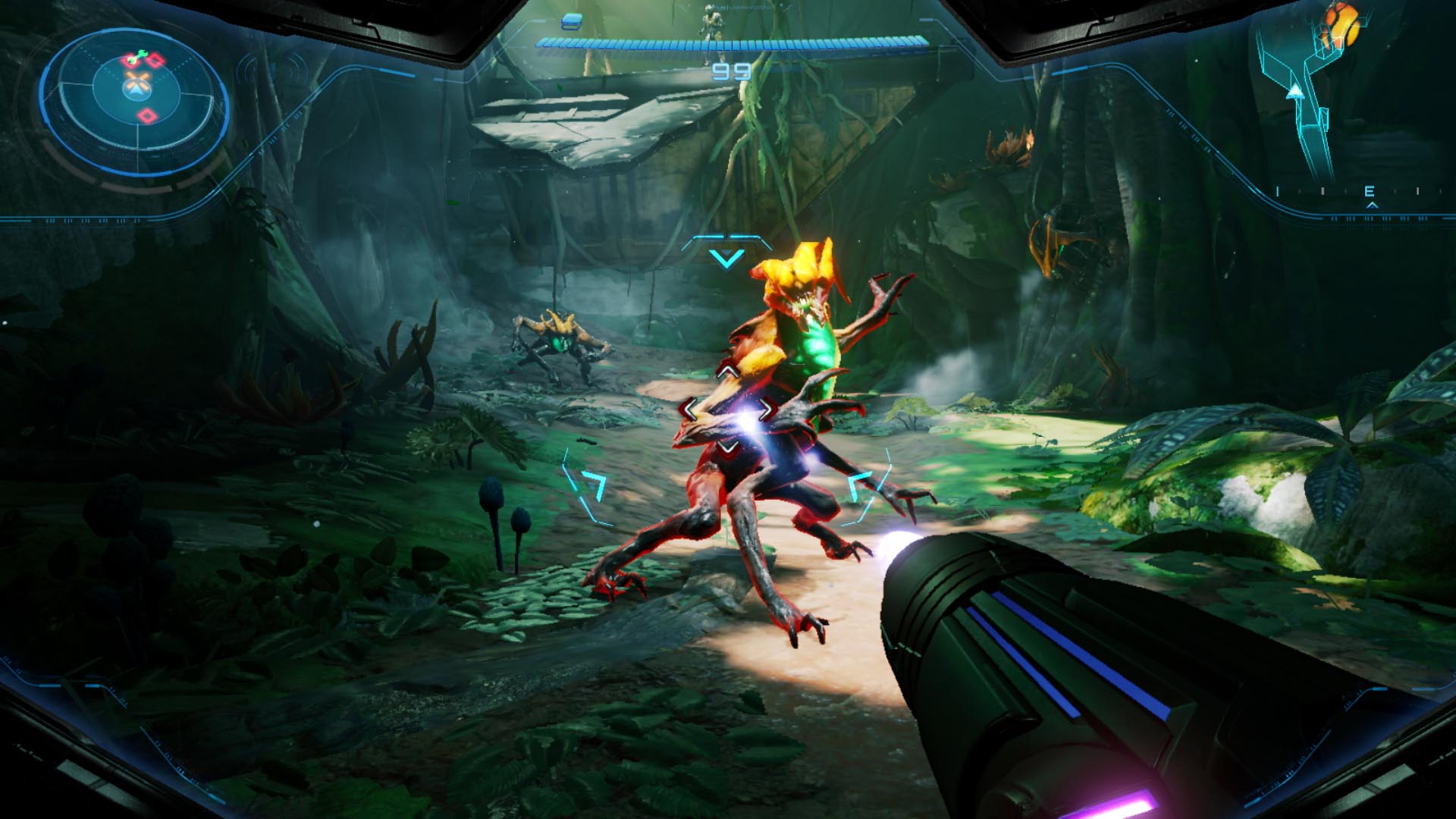
They also have a fun habit of completely screwing up the pacing of the game. Especially, if you stumble across a group of the bastards while you’ve been trying to pick up optional extras and you’re already low on health. Pro tip: Don’t forget to drop by the save stations regularly. There is an autosave. But it only activates when you achieve something tied to the main campaign. So if you say, spent two hours collecting missile and special-weapon expansions and scanning a load of random stuff, then, a little worse for wear, poor Samus gets jumped by a group of laser-toting bullet sponges and dies. Prepare to spend at least ten minutes screaming into a pillow before having to do it all over again.
The bots may be brutal, but the bosses that guard each of the keys are the kind of huge, beautifully designed, multi-phase battles that are as spectacular as they are challenging and require you to use every trick and gadget up Samus’s sleeve to succeed. Though there are times that a boss will need you to use a particular weapon, like the Contact Beam or Psychic Power Bomb, to finish them off permanently, and it’s not always clear what needs to be done.
The main downside to the boss battles is that the only checkpoint in most of them is at the beginning of the bout. This is particularly irksome if you fail to land the killing blow in a close fight and they get up, then smear you across their lair.
Occasionally, you’ll also get smacked with some cheap attack that’s almost impossible to avoid, doesn’t have half as much windup as it should, and hits like a truck.
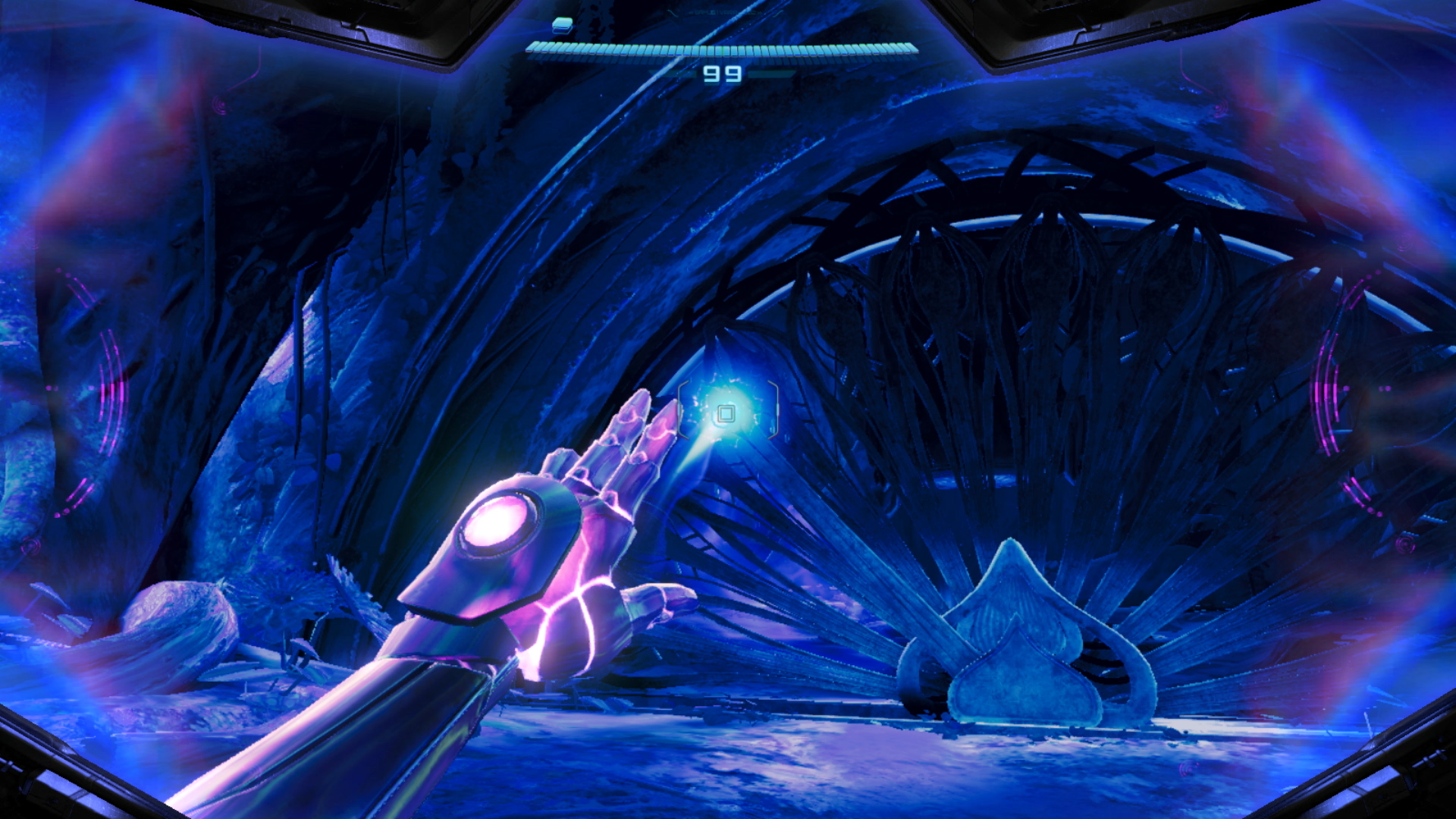
It is worth bearing in mind that although it is presented in first person, Metroid Prime 4 isn’t a first-person shooter in the traditional sense, and the controls reflect this.
Though there are options for mouse, pointer, and twin-stick aiming, you’ll still need to lock onto most enemies with ZL if you want your attacks to be effective. Ultimately which one you opt for is a matter of preference because all of them feel great, though admittedly twin stick is a little more precise, I’m a sucker for the immediacy and immersive qualities of pointer/ motion controls and although i was really excited about the inclusion of the mouse controls I didn’t use them very much even though they are a solid option too. (Pro tip for mouse mode, though: move the fire button from A to ZR. You can thank me later.)
From a Technical standpoint, Prime 4 impresses on the Switch 2; not only is the game absolutely gorgeous, but it also runs at a 60fps, or a buttery smooth (though slightly less visually arresting) 120fps. IT barely drops a frame even when the action gets incredibly intense, and there are all kinds of particle effects scattered across the screen. It also has one of the best implementations of HDR I have seen in a game in ages, and although it doesn’t support ray tracing, the baked-in lighting is absolutely jaw-dropping at times.
I would also be remiss if I didn’t mention the phenomenal soundtrack by long-time series collaborators, Minako Hamano and Kenji Yamamoto. The Prime games have always had a very distinct and ethereal soundtrack, and Prime 4 is no different. The soundtrack retains many of the same motifs as the earlier games while also creating a sound that reflects the diverse and alien world of Viewros.
Final Thoughts
It may have taken the best part of a decade to get here, but Metroid Prime 4: Beyond was certainly worth the wait. It’s an engrossing, atmospheric, and thoroughly absorbing adventure that marries modern Metroid with a surprisingly Zelda-esque hub world that favours function over form.
Regardless, the moment-to-moment first-person gameplay is still as satisfying as it ever was, while Samus’s new psychic powers are used to great effect and add some palpable puzzling to the mix, and kicking up dust in the dunes of Sol Valley while zipping along on Samus’s new steel steed is far more fun than it has any right to be.
Though combat can be a mixed bag (Every mechanical enemy on Viewros can get t’ f), the boss battles are an absolute blast, and represent some of the best set pieces, not only in the game but in the Prime series as a whole.
It’s a wonderful showcase of what the Switch 2 is capable of and by far one of the fledgling consoles’ most technically proficient games and another fine addition to the Prime series (quippy engineers aside).

Related Posts

Fallout 4: Anniversary Edition Switch 2 Review →

Two Point Museum – Zooseum DLC Switch 2 Review →

Monster Hunter Stories 3: Twisted Reflection (NS2) Review →