Dragonkin: The Banished PC Review
Summary: Dragonkin makes a mild attempt to walk among giants. With moments of great potential and elements of great design but poor implementation and lacklustre performances, this game only manages to be 'okay'
3
Explosively Average
Action RPGs are somewhat of a bloated genre these days, the format is one that is relatively easy to achieve for indie developers and triple‑A studios alike. Oftentimes it’s hard to find your place among them or to stand out in the sea of competitors. You have your standard array of content, like a menu in a restaurant. An entrée consisting of tons of fodder enemies to blast away with your physical and magical might, a main course consisting of boss monsters with HP bars larger than a full‑course meal set, and dessert made up of all the shiny loot you could want. Garnished with all the fine beverages of skills to test out and make for some delectable concoctions of explosions. Dragonkin: The Banished is no different, presenting you with a fine selection ready to be devoured at your enjoyment, the question is whether the flavour is to your liking and if it stands out amongst the giants of ARPG flavour‑town heavyweights. Will I give it a five‑star review? Come find out!
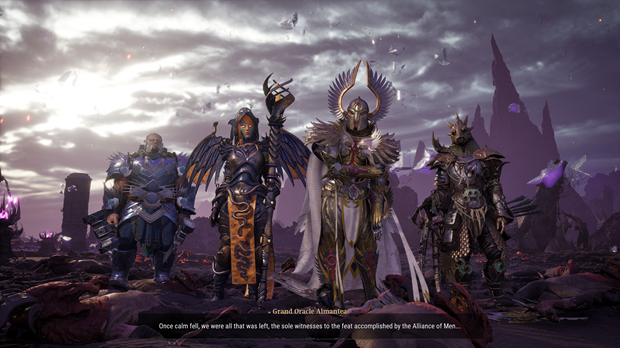
The ARPG genre truly is spoiled for choice, with titles like Diablo, Path of Exile and Titan Quest. Each with their own big bad that the game tells the audience is a world‑ending force that can only be stopped by the might of a few (namely the player and their friends). Diablo of course has… well, Diablo. In Dragonkin, it’s a demonic dragon from the underworld we’re tasked with slaying. And there’s one thing this game gets right from the very start. It introduces the big bad and shows the power it wields and the scale of it, but then immediately puts you in the shoes of the four fully powered warrior classes in the game. It does this by showing a past team of warriors that banished the dragon back to the underworld previously, placing you in each one of their shoes to learn the ropes and see just how overpowered each role can be.
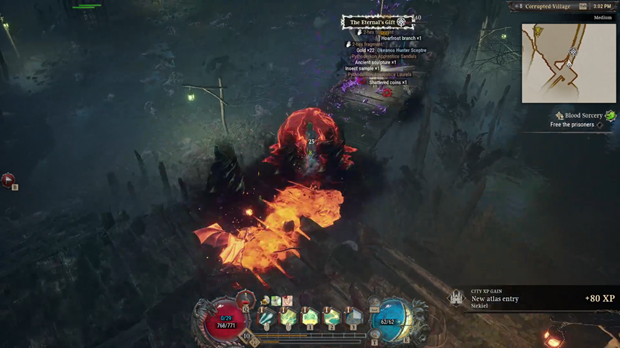
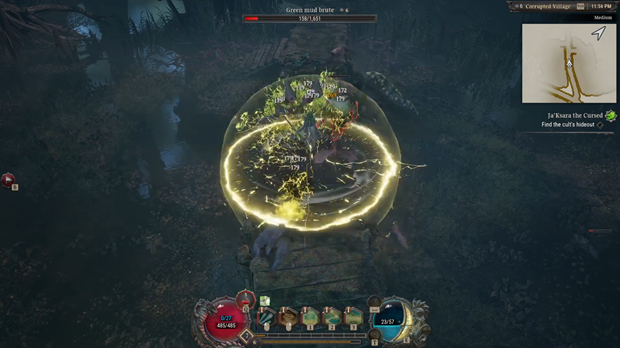
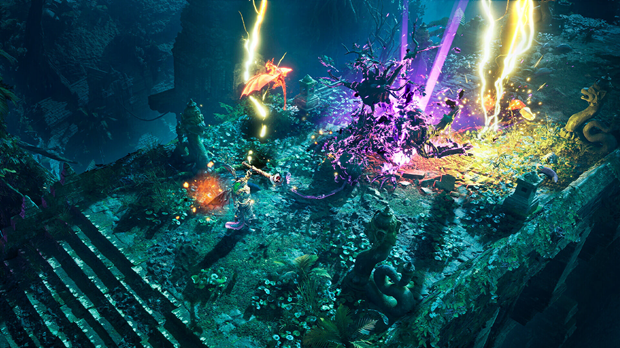
Not only does this set the stakes, but it helps to set the tone for the whole game. You know what the objective is right from the start, you know what the final result of each class will be, so you have a better understanding of what you want to play right from the beginning. You have the heavy, tank‑like barbarian, focusing on heavy physical attacks and charging through enemy lines, the knight with a fire‑spewing spear to burn through hordes en masse, the Oracle who can strike through enemies with chain lightning and blast foes backwards with explosive thunder, and the ranger who can rain down arrows into groups of charging foes and snipe stronger foes from afar. Each role has their place and each role feeds off the others. It’s very clear from my hours of play that this game was designed to be a co‑op experience, but the game doesn’t suffer too much from playing without friends, you still feel like a god smiting foes even on your own.
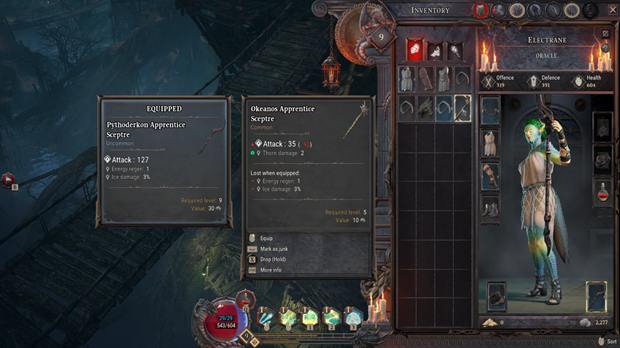
It’s a bit dissimilar from your standard ARPG, however, in that you don’t get skills as you level up in your chosen role, but rather find them the same way as you would loot or gold that is dropped by slain enemies. That’s not all, some skills are dropped with modifiers already attached, these can range from boosts to attack power, recovery or speed, all the way to helping trigger your Wyrmling skills. Wyrmling skills are cast from a little dragon companion you receive early in the game to aid you in crushing the forces of darkness. This means with luck and good RNG you can get a strong build going very early and simply swap out skills with better bonus attributes as they come. With a hexagonal skill grid that looks like some kind of electrician’s nightmare that expands in slots as you grow in levels, allowing you to place skill combinations with more bonuses and rearrange them with stats that synergise with other skills and bonuses to make for even bigger booms. It’s a simple yet intuitive system that is quite easy to understand and very rewarding to master.
Gameplay
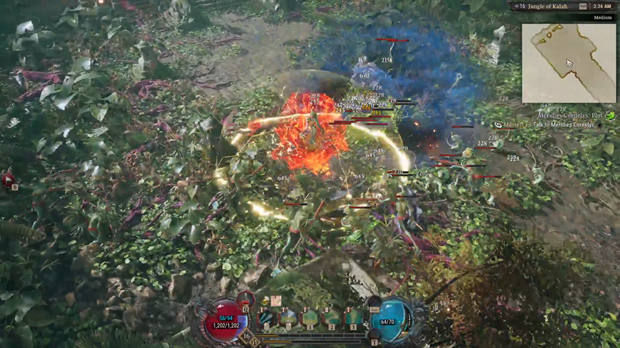
It plays like your standard affair, after the prologue shows just how insanely badass you’ll become. You’re thrust into the shoes of an acolyte, an apprentice, fresh out of the barracks and ready to prove your worth to the council and slay the ever‑growing horde of darkness and the big bad dragon at the head of the army. You visit towns, kill mobs en masse, interrupt dark rituals and complete objectives as you go and grow. With each feat getting more spectacular until you eventually, inevitably slay the big bad at the end of the game, leading into the endgame content. It’s here where the game struggles a bit, not so much with its identity, but its execution. Early on in the game, mechanics are sort of drip‑fed to the player, which is by and large normally a good thing as it allows players to fully experience and adjust to each new mechanic being introduced, however the pacing here can be very slow. It took me hours before I really unlocked any meaningful progression in the early game. And as someone that doesn’t get a lot of time to play games anymore, I really need an opening to hook me, line and sinker, if I’m going to spend days, weeks or more playing the game.
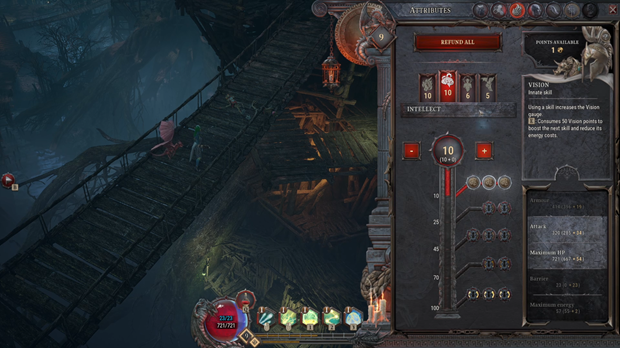
The skill system too can be a little convoluted at times as well. Once you have your Wyrmling, you need to manage its attributes and skills for each level separately and in addition to your own. That’s effectively four separate windows to check every time both of you gain a level. One each for attributes and one each for skills. In addition to this, you have this beehive‑like grid‑like ability system that allows you to place usable skills and bonuses in it to unlock new magic or skill moves depending on what class you’re playing as. You can have up to five of these unique skills active at any one time, additional skills placed into the grid will serve literally no purpose. You can find these skills dropped by slain foes or purchase them back in the city, but oftentimes finding them in the wild is better as they have the chance to come with one or more multipliers. Each group of skills and modifiers will take up slots in the grid, so the game really incentivises you to read each set and slot them in a very specific order to stack multiple modifiers and link them to other skills. It really makes the build potential for all the various classes quite intuitive and encourages heavy customisation to suit the player’s play style.
The gameplay loop is both easy and addicting to get into, not long after starting the game, and with minimal explanation, I was already throwing skill after skill at my foes and getting caught up in the rhythm. That also has a downside though, while it is fun and easy to get into, it is rather repetitive and after a while it starts to blend together and suddenly it’s been hours of gameplay that I don’t really remember much of because I got caught up in said rhythm. It didn’t stand out enough to constantly blow my mind, nor was it bad enough that I simply put it down and stopped playing. So take that however you will.
Graphics
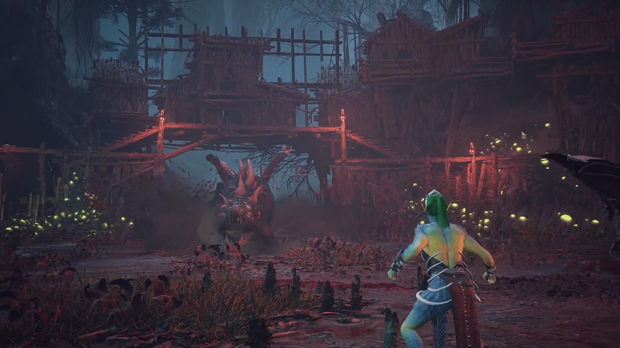
Dragonkin is… well, it’s nothing to write home about. Like my experience has been thus far, it’s not a stand‑out. It’s neither terrible nor amazing, it’s sort of just mid. It’s not going to blow my socks off, but it isn’t going to kill the experience. The UI designs are probably one of the better styles among ARPGs like this, I found it easy to understand despite how overwhelming it looks at first. And the styling and dragon motifs throughout the menus and accents are a nice touch and help to build upon the world and setting they’ve created.
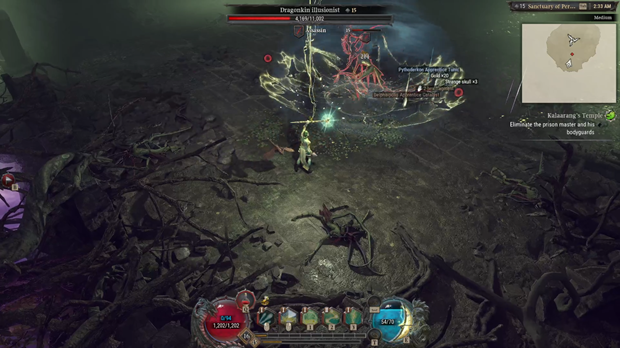
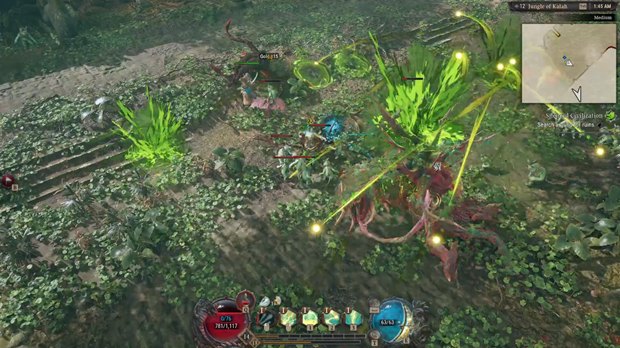
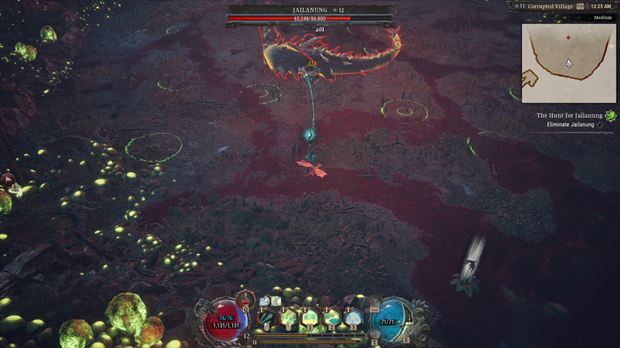
I’m not sure if it’s a consequence of the genre or if it was just a problem with this game, but I struggled to make out what a lot of the models were in this game. Animal models aside, it was hard to tell what enemies really were, standard affairs usually have different types of enemies; the scout, the grunt/fodder, the tank, the mage, etc. But for the most part I couldn’t really tell what categories most of the enemies fell into, most just ended up feeling like they were all fodder to me. Since most of them died the same way, with roughly the same amount of health. There were a few notable differences though, but these were mostly saved for designs so different to the majority, it would be impossible to mistake them for anything but different. Thankfully, boss designs are both varied and good, the grander spectacle is able to peek out from behind the veil in moments like these. Bosses are, at least, often infinitely larger and more unique.
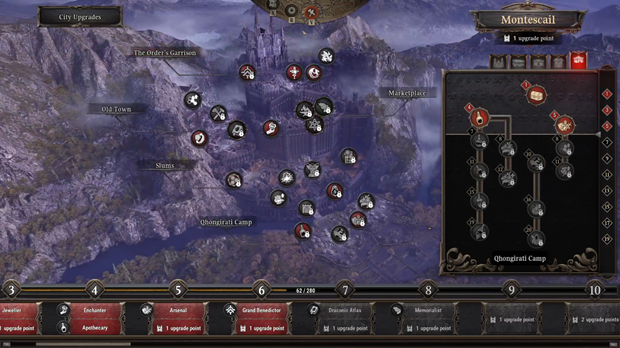
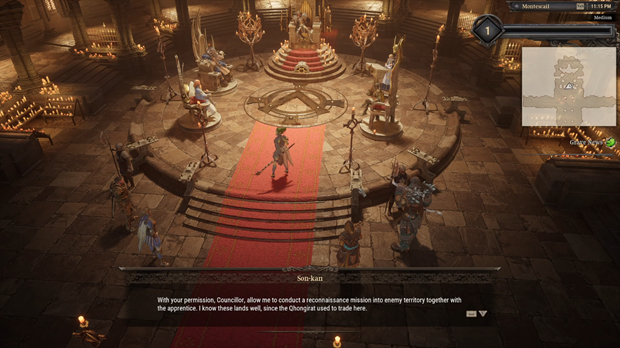
I also do love the design of the major city, I didn’t mention it in gameplay because it ultimately doesn’t affect the overall gameplay enough to be significant. But it is the last bastion of Humanity, and it grows with you as you complete your journey. It’s not as simple as just managing a skill tree for the city either. Its design changes and expands as you build and upgrade new facilities that unlock new options for growing your chosen character. The city grows along with you. It’s a concept that some city‑building games do, and it found a nice little home here in Dragonkin too.
While the game isn’t the prettiest or the grittiest, it definitely has found a nice little place right in the middle of the genre. It’s really an interesting place to find myself, not bad enough for me to rave on about how it sucks, but not going out of its way to blow my mind and draw me into its clutches to become my newest obsession game.
Audio
Audio is where this game really falls off, however, and it’s quite a shame. I’m not sure what the team’s budget was, but sound design really failed to do a good job of matching the relative strength in other areas. Music is fine enough on its own, but repeats very often, it’s almost like there is one OST per zone or maybe a small pool it chooses from, but the one track that plays for each activity repeats when it reaches its conclusion. It doesn’t change to a different song, it doesn’t increase tempo in response to action, it doesn’t have variety. All the music does suit the Middle‑earth or high‑fantasy vibe of the game, but it doesn’t feel alive with the game. It sort of just feels like it was thrown in place just so that the game isn’t silent in moments between combat and dialogue.
Sadly, this affects all aspects of the audio too. Sound effects sound cheap, I remember in my playthrough as the mage class, all of my magic skills being lightning and thunder, the sounds were simply very generic electricity sounds. And even worse, it literally seemed as though there was one sound recorded for each and then simply adjusted slightly with effects to sound ever so slightly different, but otherwise entirely unremarkable. Which is a little sad given the genre and the potential for very spectacular sound effects to go along with the power fantasy of being a mythical, epic dragon slayer and hero.
Voice acting too suffers from this problem, with bland, almost unemotional delivery and poor sound mixing, meaning that the very few voice lines that make it through the drowning sounds of combat are barely understood. In cutscenes, most of the acting is fine, but once again nothing to write home about. There’s a somewhat lack of emotion in voiced lines so the frailty and desperation of humanity’s plight isn’t really felt, it almost just ends up sounding like just another Sunday afternoon for these people. It’s the kind of deadpan performance I expect from actors who are either very tired or very bored, perhaps they’re inexperienced, in which case I only hope they watch their performances over and learn to improve their craft.
Conclusion
Dragonkin: The Banished is a game that neither impressed nor disappointed me. My experience fits squarely in the middle, there were elements of the game I felt were done really well and would love to see expanded upon. I would also love for other games to see and take notes on how some UI and skill tree elements can be designed. But there were also plenty of aspects of the game that missed or fell short of the mark. The game wants to sit on the shoulder of giants, riding their high, but all it manages to do is just barely get noticed. I fear the mediocrity of the game will only get it overlooked when other options can find a niche of being so bad that it’s good, or the genuine A‑grade titles in the genre.
As someone who grew up with Warcraft (not the MMO) and played the first Dota, I have watched the genre grow, split into various sub‑genres, expand their influence and audience. But none have really connected with me in a way that the old ARPGs did some twenty years ago. Perhaps it’s the memory of playing these with friends long since gone their separate ways, the nostalgia of those times. Perhaps the best experience of this game is to experience it with friends, but if I need friends to best enjoy a game like this, then unfortunately it’s not a game best suited to my tastes.
Game Details
Game Genre – Action RPG, Adventure
Developers – Eko Software
Publishers – Nacon Games
Rating – Mature
Year of Release – 2026
Platforms – PC (Steam)
Mode(s) of Play – Single player, Online/Offline Co-Op
You can find my other articles right here
About the Author

Daniel Hi I'm Dan! 33 and Non-Binary. When I'm not writing reviews. I like to get deeply immersed in the lore of an mmo or rpg, cruise the forest or coastal roads of Victoria, watch anime, read manga, build model kits and do a bit of sketching on the side.
Related Posts
Powerwash Simulator 2 – Star Wars DLC: Review (Steam) →
Rose & Locket Review →
Solar Punk PC Review →