
Die My Love – Film Review
Reviewed by Damien Straker on the 15th of November 2025
Madman presents a film by Lynne Ramsay
Screenplay by Enda Walsh, Lynne Ramsay, and Alice Birch based on ‘Die, My Love’ by Ariana Harwicz
Produced by Martin Scorsese, Jennifer Lawrence, Justine Ciarrocchi, Molly Smith, Thad Luckinbill, Trent Luckinbill, and Andrea Calderwood
Starring Jennifer Lawrence, Robert Pattinson, Sissy Spacek, LaKeith Stanfield, and Nick Nolte
Cinematography Seamus McGarvey
Edited by Toni Froschhammer
Music by George Vjestica, Raife Burchell, and Lynne Ramsay
Rating: MA15+
Running Time: 118 minutes
Release Date: the 6th of November 2025
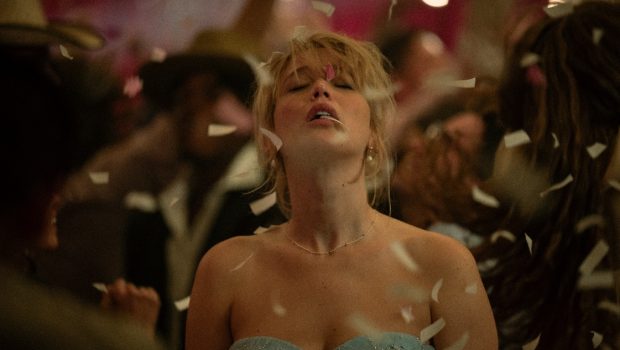
Jennifer Lawrence is magnetic in Die My Love, but the film could have been stronger. It marks director Lynne Ramsay’s first feature since the psychological crime drama You Were Never Really Here (2017). If the Joaquin Phoenix vehicle seemed abstract and mostly dependent on his actorly traits, Love completely dispenses with tight plotting and context. Ramsay’s filmic style is indebted to Terrence Malick and John Cassavetes. However, a more disciplined narrative would have complimented Lawrence’s excellent performance.
Martin Scorsese, who produced the film, first read Ariana Harwicz’s 2017 novel and recommended Lawrence for the lead role. The story opens with a couple moving into a rural Montana home. The pair are Jackson (Robert Pattinson) and Grace (Lawrence) and their baby boy. The couple is passionately involved until Grace’s behaviour grows increasingly weird.
In flashback, we see Jackson’s family living in the same home, including his father, Harry (Nick Nolte), who has dementia and his mother, Pam (Sissy Spacek). In the present, Pam undertakes her own strange quirks, such as sleeping walk down the dirt roads at night. She also possesses some personal sympathy for Grace’s erratic behaviour. Meanwhile, Grace herself continues seeing a motorcyclist (LaKeith Stanfield) skirting around the property.
Ramsay’s formal choices prove both confusing and fascinating. One of the more effective shots opens the film. The camera lies dormant in the couple’s new home. The extended shot duration is critical. It dramatises the boredom and complacency Grace now faces as a new mother. This boredom also informs her alienation and strange character behaviour. The rural woodlands setting then creates a weird psychological remoteness that further isolates Grace.
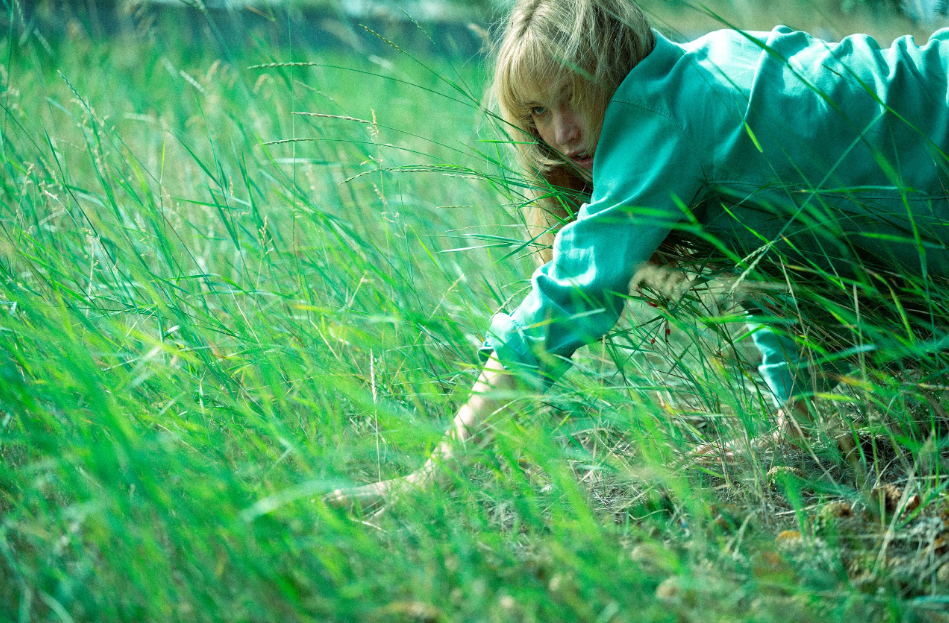
Ramsay is more interested in filming behavioural traits than story beats. She shoots Grace crawling through the grass with a knife in her hand. One interpretation is Grace is rejecting social norms and marital expectations. The conflict is expressed in the complex soundscape. Grace is constantly tormented by the family dog’s late-night barking and the crying baby. The song choices also veer between old fashioned music and metal. The formal choices underline the tension between conventional social standards and Grace’s unchained singularity.
The muddy plotting leaves us asking what the source of Grace’s trauma is. She could embody postnatal depression, alcoholism, madness, or nothing at all. For example, Grace’s fascination with the motorcyclist looks set to climax. Yet after a tensely staged meeting in a parking lot, it is still unclear whether he is real or lives comfortably in Grace’s head! There is also a flashy, confusing wedding sequence where the exact timeframe completely dissolves.
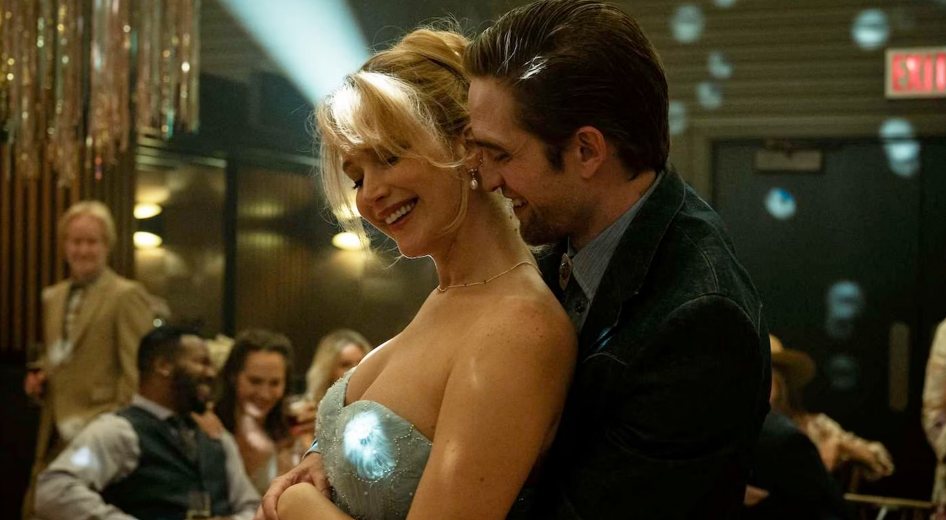
The script still possesses some interesting ideas. One example is how it dabbles with different generations. Pam seems as quirky as Grace. When Grace tears up a party, Pam raises her glass to her and smiles. Their mutual understanding marks a strong example of the film’s subversiveness. While the story is often hazy, occasionally there are some fun insights.
The film is salvaged by Lawrence’s powerful screen presence. Her bombastic personality perfectly mimics Grace’s weird outbursts. Whether imitating the family dog, childishly mocking Jackson, or engaging in self-harm, Lawrence is fearless and mesmerising. It is everything one would expect from the actress but completely alien. The child-like behaviour is undoubtedly influenced by Gena Rowlands’ performance in A Woman Under the Influence (1974).
The most enjoyable scenes involve Grace dismantling social pleasantries. She rudely dismisses a cashier for taking an interest in her baby. When another woman bores her, she takes off her clothes and dives into the neighbour’s pool. Robert Pattinson uses subtle facial expressions to express how disaffected Jackson is. By design though, Lawrence dominates, which underappreciates how interesting and weird Pattinson can be.
This is a difficult film to judge because the narrative is unwieldy. We must determine if it is strange because of the characters’ psychosis or if it is clumsily plotted. As mentioned, some of it might simply be manifesting in Grace’s mind. The bleak ending even suggests the whole film is a type of dark fable.
Yet Jennifer Lawrence still owns the screen. She is dominant, rude, impulsive, strange, and incredibly funny. The character’s behaviour is destructive, but it is thoroughly enjoyable watching her dismantle shallow pleasantries and social norms. Consequently, this is a challenging film about psychosis and recovery. It’s often confusing and elusive. Luckily, it is buoyed by one of the most commanding actresses of her generation. The experience is therefore frustrating but also deeply hypnotic.
Summary: Jennifer Lawrence is magnetic in Die My Love, but the film itself could have been stronger. The experience is both frustrating and hypnotic.
3
Flawed
About the Author

Damien Straker is a freelance writer and film critic. He studied at the University of Sydney and graduated with an Arts Honours degree in Film Studies. He is a pop culture aficionado and enjoys talking about all films, 90s TV shows, ninjas and watching Rugby League. His favourite film directors are Alfonso Cuarón, Clint Eastwood and Alexander Payne.
Related Posts

Midwinter Break – Film Review →

Sirat – Film Review →

Scream 7 – Film Review →