|
|
||
|
Albert Nobbs
Reviewed
by
Sophie Whin on
November 22nd, 2011 |
|
|
|
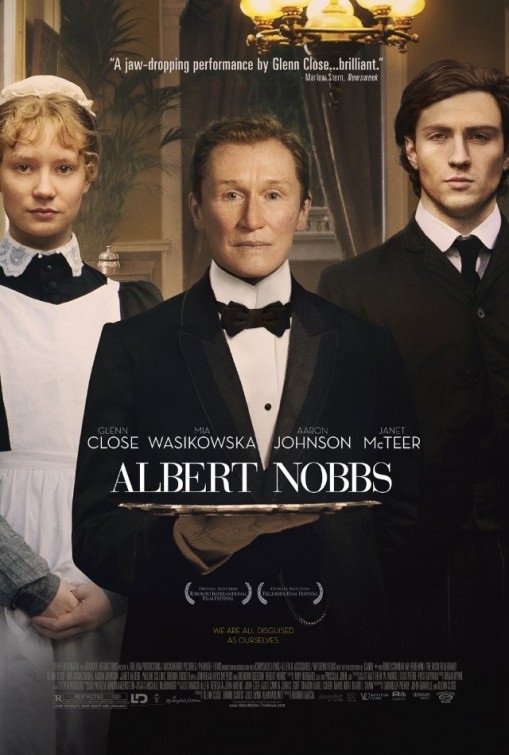
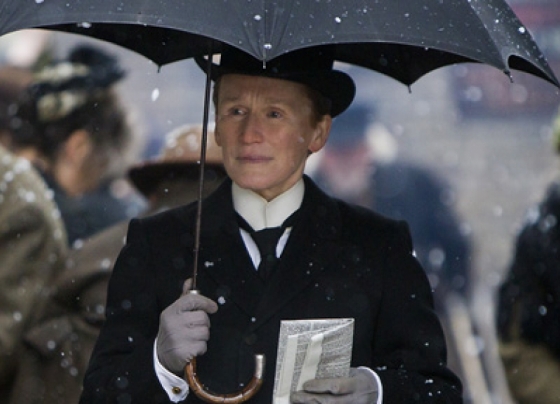
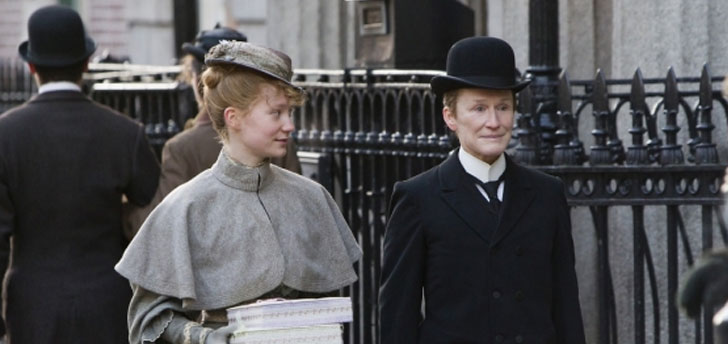
Rodrigo Garcia’s Albert Nobbs is a quiet film about one woman’s survival against the backdrop of late 19th century Ireland. With Glenn Close in the lead role of Albert and a talented group of supporting characters it is unfortunate that the film does not reach its full potential in terms of character development and a conclusive story arc. Based on the short story by George Moore, Albert Nobbs follows the day-to-day life of Albert Nobbs (Glenn Close), a butler in one of Dublin’s most luxurious hotels. Shy, reliable and completely consumed by his job, no one would suspect that he holds a deep secret: he is really a she and has been masquerading as a man for as long as she can remember. Albert’s monotonous life turns upside down when she is forced to share her room with contracted painter Hubert (Janet Mcteer), who after discovering her secret revels himself to also be a woman. Following the rude awakening that she is not the only person with a penchant for drag, Albert begins to formulate a plan to not only leave the hotel business but also to gain companionship through the courtship of the beautiful maid Helen (Mia Wasikowska). Unbeknown to Albert, Helen and her lover Joe plan to use Albert’s money to escape to America, where they believe they will have a better life.
This screen adaptation has been in the works for over three decades. In 1982 Glenn Close starred in the off Broadway interpretation of Simone Benmussa’s ‘Albert Nobbs’ and has since rallied for years to bring about a cinematic representation. Fortunately, with director Rodrigo Garcia Close’s dream has finally become a reality, despite its relatively linear and unchanging narrative. The story is dominantly character driven by Albert Nobbs but this does not excuse the weak surrounding players and their relatively joyless lives. It is hard to grasp if Garcia wanted to make this a black comedy, a serious drama or a failed combination of the two. The elements of comedy are a breath of fresh air in comparison to the long stretches of pointless dialogue and over focus on Close’s stuttering Nobbs. This is the film’s main triumph as well as it greatest set back: the actual character of Albert Nobbs. He does not identify himself as a man nor really as woman, and his perspective on the world can be likened to a child’s naivety in terms of how he interacts with the hotel staff and his misadventures concerning courtship. It is only when he actively pursues his dream of starting his own business that the audience glimpses a deeper personality that is far stronger than the meek front he puts first.
The sets and
costumes are suitably muted with design of the film keeping in step
with the
style of 19th century Dublin. We are witness to both ends of
the
spectrum with shots of the dazzling and luxurious hotels to the dull
and
lifeless workers quarters. Although the shooting is predominantly
within the
hotel, the outside exterior scenes are beautiful and add a semblance of
reality
to the peculiar antics inside. The film is of course focused singularly
on the
performance of Close. Her transformation into Albert is bizarre but
brilliant
and it will be no surprise if Oscar nominations are not in her future.
Aaron
Johnson and Mia Wasikowska as the tragic couple are too unlikeable and
the
audience is left wondering why Albert set his sights on Helen, who is
too young
to know what she really wants. Brendan Gleeson and Jonathan Rhys Meyers
both have
small appearances, but it is Janet Mcteer’s Hubert who really pumps
some life
into a story that would otherwise be quite tedious. She plays a male
far better
than Albert and through her mentorship Albert can finally come to grips
with
who or what she is. Albert
Nobbs is
released this week and should be watched only for the stellar
performances from
Close and Mcteer. Perhaps if Albert was a more interesting lead the
entirety of
the film would have had a more fulfilling journey and conclusion. |
||